One of the most common questions we hear at Temis Motorsports is simple: “What subwoofer should I buy?” And the answer, unfortunately, is never one-size-fits-all. The right subwoofer for a Fort Lauderdale commuter’s Honda Accord is completely different from the right choice for a performance enthusiast’s custom SPL competition build.
But here’s the good news: choosing the right subwoofer doesn’t have to be complicated. You just need to understand a few key factors that actually matter, tune out the marketing noise, and match the subwoofer to your specific goals.
In this guide, we’ll walk through everything you need to know about subwoofer selection—from sizes and power ratings to enclosure types and how to match your subwoofer to the rest of your system.
Why Subwoofers Matter: The Missing Piece of Factory Audio
Your car’s factory audio system has a critical weakness: it can’t reproduce bass. Most factory speakers are small (3-6 inches in diameter) and designed for midrange and high frequencies only. They’re physically incapable of moving enough air to produce bass frequencies below 60-80 Hz.
This is where subwoofers come in. A subwoofer is a specialized speaker designed specifically to reproduce low-frequency content—the deep bass that adds power, impact, and emotional resonance to music.
Without a subwoofer:
- – Bass feels thin and weak
- – Music lacks impact and fullness
- – You’re missing the lower half of the audio spectrum
- – High-powered amplifiers have nowhere productive to send their energy
With a quality subwoofer and amplifier:
- – Music has genuine bass impact and weight
- – You feel the music, not just hear it
- – The entire frequency spectrum is represented
- – Your favorite songs sound the way artists intended
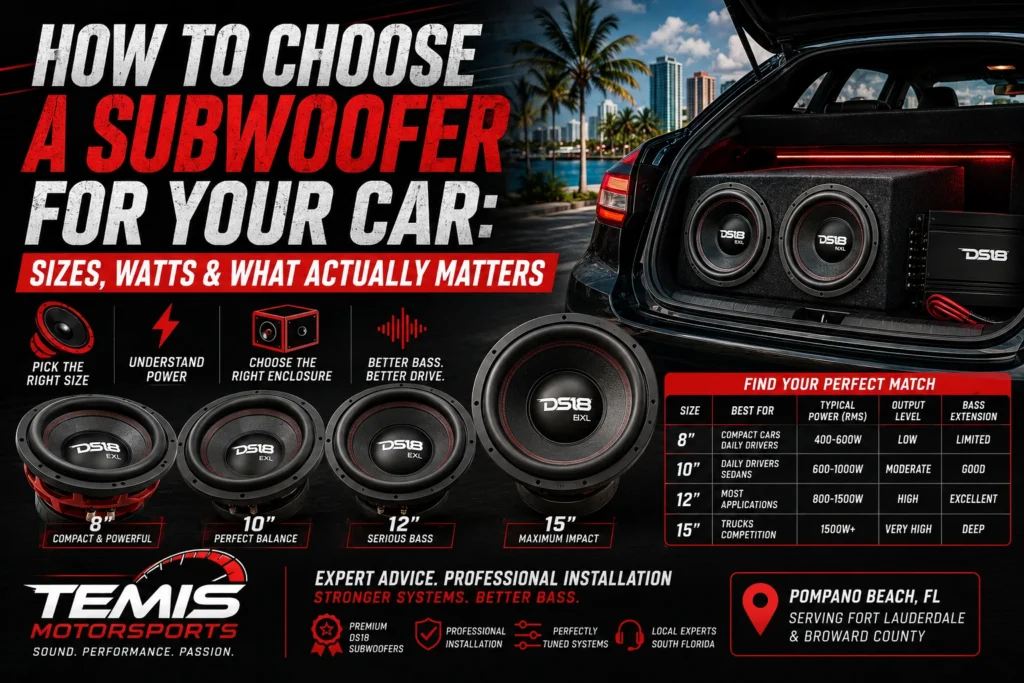
Subwoofer Sizes Explained: 8″, 10″, 12″, and 15″
Subwoofer size refers to the woofer cone diameter—the moving part that produces sound. Larger sizes move more air and typically produce louder bass, but size also affects frequency response, enclosure space requirements, and installation options.
8-Inch Subwoofers
**Best for**: Compact vehicles, daily drivers, music lovers who want bass without overwhelming output, space-limited installations
**Advantages**:
- – Smallest physical footprint
- – Fits in virtually any vehicle (compact cars, sedans, hatchbacks)
- – Lower power requirements (400-600W RMS typical)
- – Fast transient response (excellent for hip-hop and electronic music where bass attack is important)
- – Usually most affordable
- **Disadvantages**:
- – Lowest output level
- – Shallower bass extension (may not reach very low frequencies)
- – Requires higher crossover frequency
**Typical Applications**: Daily drivers, compact vehicles, secondary systems, vehicles where trunk space is premium.
10-Inch Subwoofers
**Best for**: Most daily drivers and budget-conscious buyers, good all-around choice
**Advantages**:
- – Compact yet more output than 8-inch
- – Fits comfortably in most vehicles (sedans, SUVs, trucks)
- – Moderate power requirements (600-1000W RMS typical)
- – Excellent frequency response and detail
- – Good balance of size, output, and performance
**Disadvantages**:
- – Mid-range pricing (more expensive than 8″, less than 12″)
- – Still not the deepest bass
**Typical Applications**: The most popular size. Works well for daily drivers, music enthusiasts who don’t need extreme output.
12-Inch Subwoofers
**Best for**: Performance enthusiasts, larger vehicles, those who want serious bass output
**Advantages**:
- – Excellent output levels
- – Good frequency response across the entire bass spectrum
- – Works well in both sealed and ported enclosures
- – Most flexible size (performs well in various enclosure designs)
- – Most common in aftermarket audio (widest selection of models)
**Disadvantages**:
- – Larger enclosure requirements
- – Higher power requirements (800-1500W RMS typical)
- – Takes up more trunk/vehicle space
- – Heavier weight
**Typical Applications**: Performance builds, larger vehicles, those prioritizing serious bass output.
15-Inch Subwoofers
**Best for**: SPL competition, maximum bass output, large vehicles with plenty of trunk space
**Advantages**:
- – Maximum output levels
- – Excellent for very deep bass
- – High-impact performance
**Disadvantages**:
- – Largest enclosure requirements
- – Highest power demands (1500W+ RMS typical)
- – Significant trunk space commitment
- – Overkill for most daily drivers
**Typical Applications**: Competition vehicles, full-size trucks, bass enthusiasts who prioritize volume over all else.
Understanding Power: RMS vs. Peak Power Explained
When shopping for subwoofers, you’ll see two power ratings: **RMS** and **Peak Power**. These numbers are very different, and understanding them prevents buyer confusion.
**RMS (Root Mean Square)**: This is the continuous, sustained power the subwoofer can handle all day long. RMS power is the honest, real-world power rating. A 500W RMS subwoofer can safely and reliably operate at 500 watts of power continuously.
**Peak Power**: This is the maximum instantaneous power spike a subwoofer can theoretically handle for a brief moment. Peak power numbers are always much higher than RMS (sometimes 2-3x higher) and are often emphasized in marketing because the numbers look more impressive.
**Which one matters?** RMS is what actually matters for real-world performance. When comparing subwoofers, always compare RMS-to-RMS, not peak-to-peak.
**Example**: A subwoofer rated at “1000W Peak / 500W RMS” is actually a 500-watt subwoofer. The peak number is just marketing.
Voice Coil Configuration: Single vs. Dual Voice Coil
A voice coil is the coil of wire inside the subwoofer that receives electrical signal from the amplifier. Voice coil configuration affects how the subwoofer connects to your amplifier and what impedance options are available.
Single Voice Coil (SVC)
- **Configuration**: One coil per subwoofer
- **Impedance Options**: Usually 4Ω or 8Ω
- **Best for**: Simple systems with one subwoofer, budget builds
- **Wiring**: Straightforward—direct connection to amplifier
Dual Voice Coil (DVC)
- **Configuration**: Two independent coils per subwoofer
- **Impedance Options**: Each coil can be 4Ω or 8Ω, allowing flexibility in final impedance (1Ω, 2Ω, 4Ω, or 8Ω depending on wiring)
- **Best for**: Multiple subwoofers, complex systems, those who want flexibility
- **Wiring**: Coils can be wired in parallel or series to achieve desired impedance
- **Impedance matching**: Dual voice coil subwoofers give you options when wiring multiple subs to match your amplifier’s specifications.
Most modern car audio systems use DVC subwoofers because of the flexibility and options they provide.
Enclosure Design: Sealed vs. Ported
How your subwoofer is mounted and enclosed dramatically affects bass output, frequency response, and the listening experience. There are two primary types:
Sealed Enclosures
**Design**: Airtight box with the subwoofer mounted to the front
**Characteristics**:
- – Smaller enclosure volume required
- – Tight, accurate bass response
- – Clean sound with good transient response (tight attack on bass notes)
- – Lower overall output level
- – Linear bass extension
**Best for**: Daily drivers, music lovers who prioritize accuracy, folk/acoustic/classical music, those with limited trunk space
**Typical volume**: 1-1.5 cubic feet per 12-inch subwoofer
Ported Enclosures
**Design**: Sealed box with a “port” (tuned opening) that allows air to move in and out
**Characteristics**:
- – Louder output levels than sealed (3-6 dB more)
- – Enhanced bass response at port tuning frequency
- – More spacious-sounding bass
- – Can produce “boomy” bass if poorly designed
- – Requires more enclosure volume
**Best for**: Bass enthusiasts, hip-hop/electronic/pop music, those wanting maximum output, larger vehicles
**Typical volume**: 2-3 cubic feet per 12-inch subwoofer
**Which is better?** Neither—they’re different tools for different goals. Sealed enclosures provide accuracy; ported enclosures provide output. Your music preferences and vehicle space determine which is right for you.
DS18 Subwoofer Lines: What’s Available
At Temis Motorsports, we specialize in DS18 subwoofers—a Miami-based brand engineered specifically for South Florida’s climate and driving conditions.
**DS18 EXL Series**: Known for excellent sound quality, tight bass response, and reliability. Perfect for music lovers and daily drivers who want clarity alongside impact. Available in 8″, 10″, 12″, and 15″ sizes in both SVC and DVC configurations.
**DS18 NXL Series**: High-output competition subwoofers built for SPL enthusiasts and those who want maximum bass output. Engineering focuses on power handling, durability, and extreme output levels. Popular in competition vehicles and performance builds.
Both lines are built with quality cones, surrounds, and magnet structures designed to withstand the heat and humidity of South Florida and years of reliable service.
Subwoofer Sizing Comparison Table
| Size | Best for | Enclosure Volume | Typical Power | Output Level | Bass Extension |
|——|———-|——————|—————|————–|—————–|
| 8″ | Compact cars, daily drivers | 0.5-1 cu. ft. | 400-600W RMS | Low | Limited |
| 10″ | Daily drivers, sedans | 0.75-1.5 cu. ft. | 600-1000W RMS | Moderate | Good |
| 12″ | Most applications | 1.5-2.5 cu. ft. | 800-1500W RMS | High | Excellent |
| 15″ | Trucks, competition | 2.5-4 cu. ft. | 1500W+ RMS | Very High | Deep |
Matching Your Subwoofer to an Amplifier
Choosing a subwoofer is only half the equation. Your subwoofer needs an amplifier to function, and matching them correctly is essential for optimal performance.
- **Power Matching**: Your amplifier’s RMS output should be close to the subwoofer’s RMS rating. A 500W RMS subwoofer works best with a 400-600W RMS amplifier. Underpowering wastes subwoofer potential; overpowering risks damage.
- **Impedance Matching**: Your subwoofer’s final impedance (after voice coil configuration) must match your amplifier’s specifications. Most car audio amplifiers are rated at 4Ω or 2Ω per channel.
- **Crossover Setting**: Your amplifier’s crossover (high-pass and low-pass filters) determines what frequencies reach your subwoofer. Typically, subwoofer crossovers are set between 60-120 Hz, depending on your speakers and system goals.
- **Gain and Signal Matching**: Professional installation includes proper gain setup to ensure clean signal transfer from your head unit to your amplifier.
At Temis Motorsports, we handle all these technical details during your consultation and installation.
Installation Matters: Why Professional Setup Is Essential
A subwoofer’s performance is only as good as its installation. Proper installation includes:
- – **Correct enclosure design** (sealed or ported, precisely tuned)
- – **Secure mounting** (subwoofer won’t rattle or move)
- – **Proper power wiring** (correctly sized cables, proper fusing)
- – **Signal wiring** (high-quality RCA cables, properly shielded)
- – **Amplifier placement** (proper ventilation, secure mounting)
- – **Fine-tuning** (gain adjustment, crossover optimization, phase alignment if multiple subs)
A poorly installed subwoofer will sound muddy, boomy, and disappointing. A professionally installed subwoofer will reveal new depth and impact in your favorite music.
Your Next Step: Subwoofer Installation in Pompano Beach & Fort Lauderdale
Choosing the right subwoofer doesn’t have to be overwhelming. Our team at Temis Motorsports has installed thousands of subwoofer systems across Pompano Beach, Fort Lauderdale, Broward County, and throughout South Florida. We understand local climate challenges, space constraints in various vehicles, and how to match components perfectly.
When you’re ready to add bass to your system, bring your vehicle to our Pompano Beach location. We’ll discuss your vehicle, music preferences, budget, and goals—then recommend the perfect subwoofer and amplifier combination for your needs.
FAQ
- **Q: What’s the minimum power I need for a subwoofer to work?**
- A: Technically, even a 50W powered subwoofer will produce bass. However, for quality car audio, we typically recommend at least 300-500W RMS for noticeable, clean bass output. Less than that and you won’t feel much impact; more is better for louder, more dynamic bass.
- **Q: Can I use a powered subwoofer in my car instead of separate amp and sub?**
- A: Yes, powered subwoofers (amplifier built-in) are available and work well in compact vehicles. However, separate amplifier and subwoofer combinations offer more flexibility, better sound quality, and more power options. For serious car audio builds, we recommend the separate approach.
- **Q: Will a subwoofer fit in my sedan?**
- A: In most cases, yes. Even compact sedans can fit a 10-12″ subwoofer in a properly designed enclosure. We’ll assess your vehicle during consultation and recommend sizes and placements that work with your trunk space and vehicle type.
- **Q: How much will I notice a subwoofer if I mainly listen to classical or acoustic music?**
- A: You’ll notice the improvement in bass weight and fullness, even with acoustic music. Classical instruments have bass frequencies, and a subwoofer helps reproduce them accurately. Sealed enclosures are often preferred for this use because they provide tighter, more accurate bass response.
- **Q: Can I install a subwoofer myself, or do I need professional installation?**
- A: While possible, professional installation is highly recommended. Improper installation can result in poor sound quality, damage to your vehicle, electrical safety issues, and warranty problems. Our professional installers ensure proper enclosure design, power wiring, signal routing, and fine-tuning that you’d be unlikely to achieve yourself.
- **Q: Do I need sound deadening if I’m adding a subwoofer?**
- A: Sound deadening improves overall system performance and is especially valuable in South Florida’s heat and humidity. It reduces road noise, improves bass clarity, and protects components. We recommend it for complete systems, though it’s technically optional.
- **Schema Markup Note**: Use Product schema for subwoofer category pages. Use HowTo schema for the sizing and selection comparison content. Use FAQPage schema for the FAQ section.